'An incorrect judgement' – How McLaren got their sums wrong on Sepang tyre strategy
Team Principal Andrea Stella has explained how McLaren took a wrong step in tackling the challenging conditions at the start of the Bahrain Grand Prix in Malaysia.
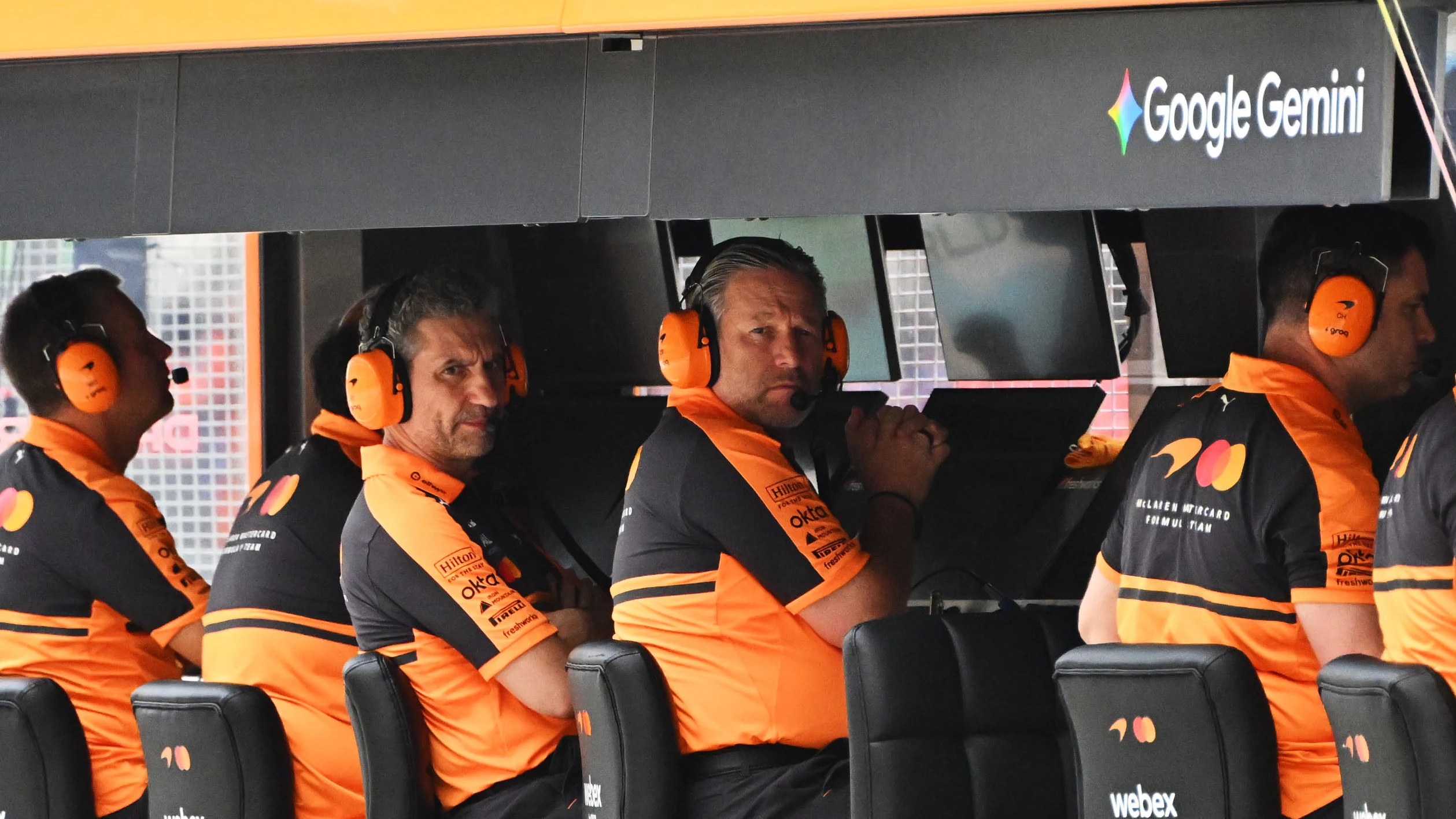
Just eight days after the team failed to score any points in the Azerbaijan Grand Prix, McLaren endured another painful race day at Sepang.
It wasn’t quite as bad as Baku, but nevertheless P6 for Oscar Piastri and P9 for Lando Norris was not what the team needs or expects.
On a day when there were many strategy calls to be made, the team got the big one wrong when they opted to put both drivers on medium tyres for the start – a decision that seemed logical at the time but which was soon proved to be incorrect.
Historically Sepang is a track that dries relatively quickly, and thanks to its rough surface, puts heat into dry tyres and allows them to work even in damp conditions. That knowledge pushed McLaren and others into starting on slicks.
“At the pit wall, in terms of making calls and strategy on tyres, the most difficult moment was certainly at the start,” Team Principal Andrea Stella noted. “Where it wasn't clear [was] whether the track was requiring intermediate tyres, or it would work for the dry tyres.
“On this kind of tarmac already what we saw on the laps to the grid is that the intermediate tyres were getting damaged very rapidly, and also on this kind of tarmac, the dry tyres work very, very easily – much more easily than pretty much every other circuit.
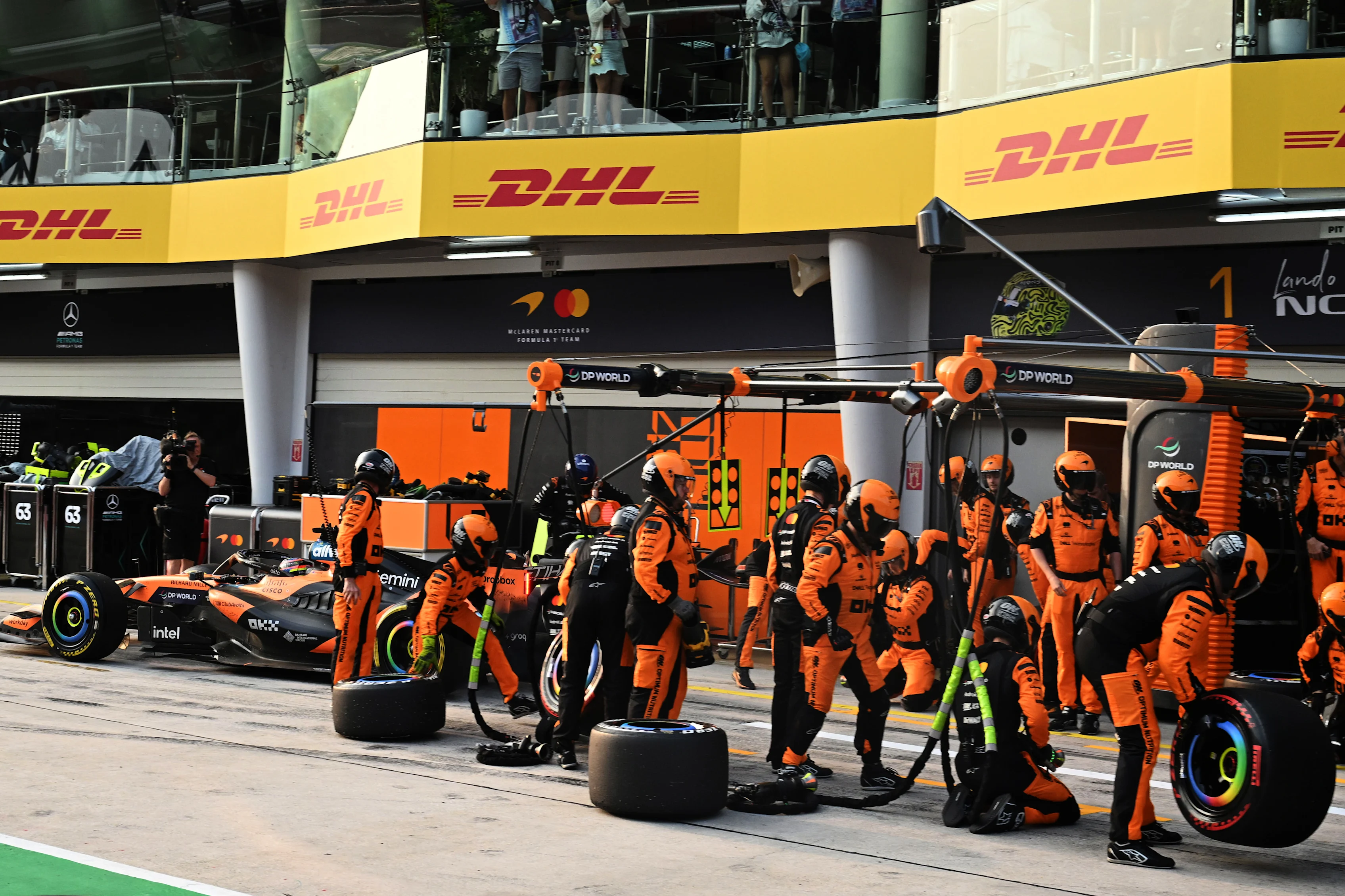
“So it looked, from what we could observe, that the track was dry enough to stay on track with the dry tyres, and we thought that the dry tyres would have switched on pretty rapidly. But as a matter of fact, it took more laps than we thought.
“So with Lando we lost race time, and with Oscar as well, we lost race time because we needed to pit and accept that the track was only right for intermediate tyres. This was the most complicated moment.”
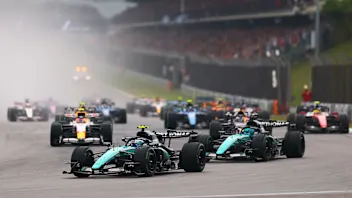
Piastri made a decisive call and pitted for intermediates at the end of the second formation lap, throwing away his grid position but at least putting himself on the right tyres.
The slick runners struggled so much that by the end of the first flying lap he was already back up to P10, just four spots shy of his starting position. Norris, meanwhile, had soon tumbled down to P15, and like the others still on dry tyres he lost huge chunks of time each lap.
McLaren were one of several teams where one driver pitted, and the other stuck with the slicks. However, that wasn’t a big picture choice.
“No, it wasn't as simple as splitting,” said Stella. “It was more the uncertainty as to how much it would take for the dry tyres to start to work, and as a matter of fact, it took longer than what we thought it would take.
“So ultimately, it was an incorrect judgment as to the crossover at which the dry tyres would be faster than the intermediate tyres. But there was not a logic as simple as saying, ‘Let's split, and let's see what which one is right.’ We thought that the dry tyres would switch on faster.”
The drivers had their input, as Stella confirmed: “I think for Oscar it was sort of Oscar himself thinking like it's not going to be rapid, and I think with Lando, it's possible that we biased Lando in the wrong direction.
“I think he was probably more in the direction that he should have pitted for inters, but as we discussed, we kind of attempted to see whether we could stay out on the medium tyres.”
By the last Safety Car, Piastri and Norris had made it up P7 and P8. George Russell’s late retirement handed the Australian a place, but Norris was wrongfooted when the Safety Car queue backed up, and he dropped to P11. After the restart he managed to gain a couple of places.
McLaren did thus at least score some points, but this was by no means a good weekend for a team that was winning races just a few weeks ago.
“We see a scenario in F1 which seems to be changing pretty rapidly,” said Stella. “In Hungary, we took some upgrades, and we were in condition to have pole position in Hungary, Zandvoort, and then we were in condition to do pole position and pretty much victory in Madrid without the Virtual Safety Car.
“And then very rapidly and interestingly, as we took upgrades as well, the picture changes. I think we have to take a look at our own development.
“We don't see any anomaly in our data, but we have to acknowledge that potentially some competitors have developed their car with bigger steps that we did.”
Stella admitted that the pecking order is hard to judge at the moment, especially after a race an outlying track like Sepang. He reserved judgement on what we might see in Singapore next weekend.
/GettyImages-2298517006.webp)
“It's a very special condition here in Malaysia,” he said. “So I think we'll have to understand better the behaviour of the cars, and also here Ferrari were very, very strong.
“I think you see that [Lewis] Hamilton was out there with Lando, and from that position he managed to recover several positions, overtaking cars through the race, meaning that it was definitely one of the best cars out there.
“I think we need to give ourselves some more time. I'm personally not in condition to say if Singapore will be now more suitable or not, because from a track layout point of view, we thought that here would be a decent circuit for us, and this because of the uncertainty caused by the new scenario from a competitiveness point of view, but also because we might have to understand a bit better the upgrades that we took ourselves. And Singapore will give us a better answer.”
.webp)
Next Up
Related Articles
 All the key moments from the 2026 Bahrain GP in Malaysia
 BettingSingapore Grand Prix betting guide and latest odds
 Unlocked5 winners and 5 losers from the Bahrain GP in Malaysia
 What the teams said – Race day in Malaysia
  Betting5 betting lessons after Verstappen wins Bahrain GP
 The 2026 Qualifying and race head-to-heads so far