What tyres will the teams and drivers have for the 2026 Barcelona-Catalunya Grand Prix?
As F1 prepares to race in Spain, which tyres have Pirelli chosen for the Barcelona-Catalunya Grand Prix?
After racing on the streets of the Principality in Monaco last weekend, the teams and drivers head to Barcelona for the seventh round of the season.
The allocation provided by Pirelli includes the C2 for the hard, C3 for the medium and C4 for the soft, which is a step softer than usual at the Circuit de Barcelona-Catalunya on a weekend where track temperatures are expected to be high.
Drivers will get two sets of the hard tyre (marked white), three sets of the medium tyre (marked yellow), and eight sets of the soft tyre (marked red), as well as access to the green intermediate tyre and the blue full wets, should they be required.
An extra set of softs is reserved for those who reach Q3 in Qualifying, while all drivers must use at least two different slick compounds during the race, providing the track is dry.
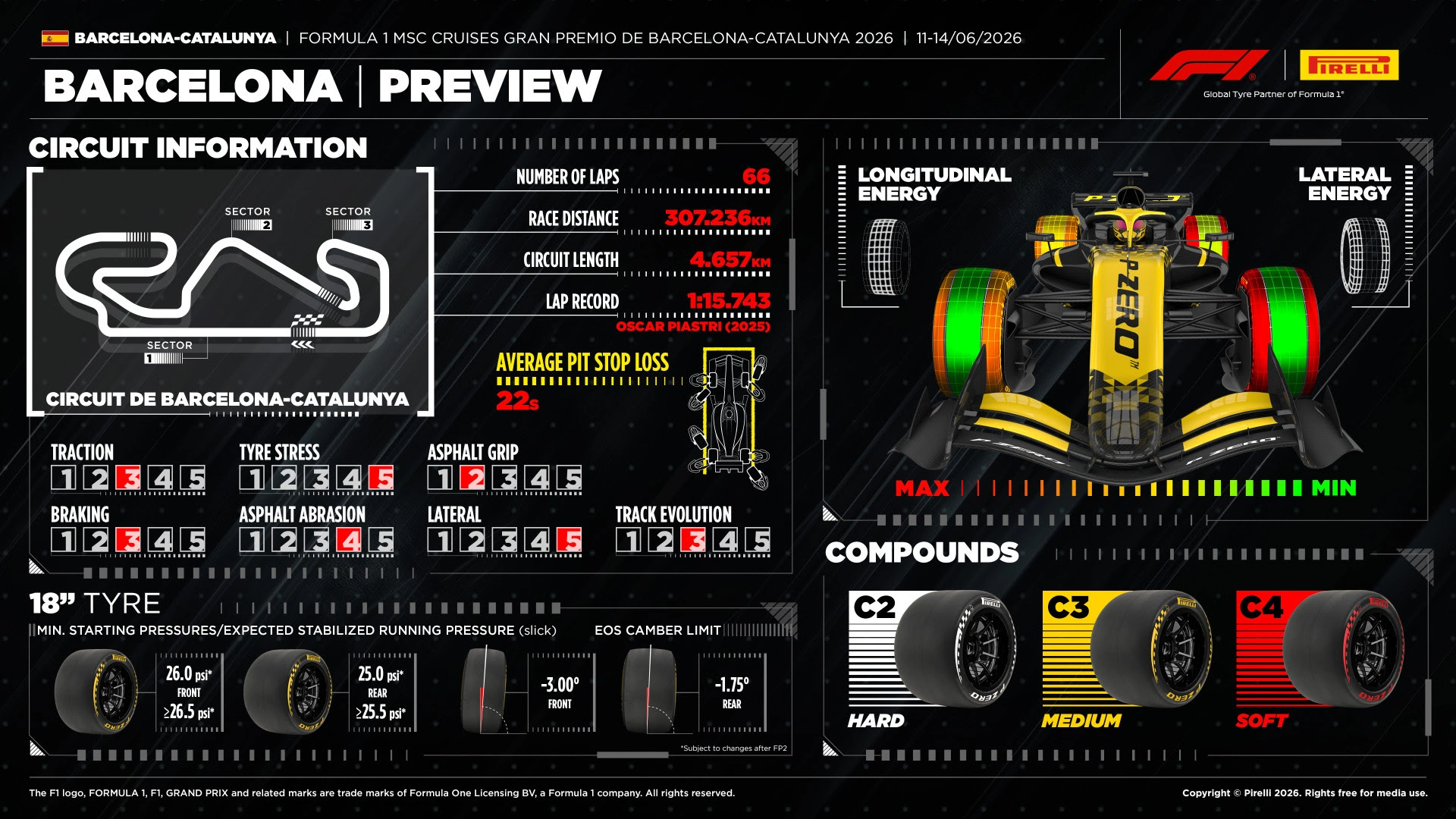
"After six months, the new Formula 1 cars are set to return to the Barcelona-Catalunya circuit," reads Pirelli’s weekend preview. "The current season in fact began at the Spanish venue, with five days of pre-season testing last January, allowing teams to familiarise themselves with the single-seaters that were completely revolutionised by the current technical regulations.
"The teams will head back to Catalonia this weekend for the race weekend that takes its name from the city and the autonomous community, with the national designation this season instead assigned to the new Grand Prix that will be held in Madrid in September. Compared with its original slot on the calendar, the Montmeló race has been postponed by a couple of weeks.
"The compounds selected for this round are C2 for the hard, C3 for the medium and C4 for the soft. This is therefore a softer trio than the usual selection for Barcelona. Given the characteristics of the current compounds, the aim is to encourage a greater number of pit stops and also the inclusion of the hard tyre in race strategies.
"The track is one of the most complete on the calendar and is 4.657 kilometres long. As well as the straights, it features 14 corners that are taken at high speeds. The lateral forces exerted on the tyres are high, particularly on the left-hand side, which is more heavily stressed by the nine right-hand corners. The most significant in this respect are Turn 3 and the final two corners, which were re-profiled in 2023 to make the entry onto the pit straight more flowing.
"Tyre degradation is predominantly thermal and, as with wear, the front axle is the limiting factor. The asphalt is very abrasive due to the advanced age of the track surface. It should also be taken into account that track temperatures are likely to be higher than those recorded in recent years, given the change in the date of the race.
"It will be interesting to assess what upgrades the teams bring this weekend, traditionally one that is rich in developments to the cars. These could also involve the wheel rims, which have a direct impact on heat exchange between the asphalt, the tyres and the braking system. An easy performance benchmark for the teams will be the January tests held at the same circuit."
Pirelli will also remain at Montmeló on Tuesday and Wednesday, June 16-17, for a session of slick tyre testing, with Ferrari, Aston Martin and Cadillac taking part in the two-day test.
For more information about Pirelli’s F1 tyres, visit pirelli.com.
Next Up
Related Articles
 Perez reflects on 'one of my best weekends'
 Where does Russell’s Baku win rank in the closest F1 finishes?
 UnlockedTop 10 most memorable F1 moments at Sepang
 What tyres will the teams have for the Bahrain Grand Prix?
 Ocon confirms he will leave Haas at end of 2026 season
 BettingThe 5 drivers most likely to win the Bahrain GP